In this section, I’ve tried my best to include blog description examples from top blogs of various niches like tech, health, fitness, travel, coding, lifestyle, etc.
This is a C Program to calculate the sum & average of an array.
Problem Description
We have to write a program in C such that we are reading an array of N elements and then we are going to calculate the sum and average of those N elements and display it to the standard output or screen.
Expected Input and Output
If we are entering 5 elements (N = 5), with array element values as 10, 20, 30, 40 and 50 then, 1. Sum of Elements of the array will be: 10 + 20 + 30 + 40 + 50 = 150 2. Average of Elements of the array will be: 150 / 5 = 30
Problem Solution
Fundamentally, an array is a data structure containing a collection of values or variables. The simplest type of array is a linear array or one-dimensional array. An array can be defined in C with the following syntax: int Arr[5] = {10, 20, 30, 40, 50}; /* here 10,20,30,40,50 are the elements at indices 0,1,2,3,4 respectively */
In this example, array Arr is a collection of 5 integers. Each integer can be identified and accessed by its index.
The indices of the array start with 0. So, the first element of the array will have index 0, the next will have index 1 and so on. For example, if we have to add 20 to the 2nd element, then the syntax will be: Arr[1] = Arr[1] + 20; (we can also use Arr[1] += 20;)
advertisement
For the solution, we will first construct an array with user-defined length and then, we will find its sum and average.
The formula for the average of the array will be: average=Σ(elements of the array)/number of elements in the array
Simply, we will add all the elements of the array and then divide it with the number of the elements to find the averag
What is WordPress? At its core,WordPress is the simplest, most popular way to create your own website or blog. In fact, WordPress powersover 37.6%of all the websites on the Internet. Yes – more than one in four websites that you visit are likely powered by WordPress. On a slightly more technical level, WordPress is an open-source content management system licensed under GPLv2, which means that anyone can use or modify the WordPress software for free. A content management system is basically a tool that makes it easy to manage important aspects of your website – like content – without needing to know anything about programming.
The end result is that WordPress makes building a website accessible to anyone – even people who aren’t developers.
What Kinds Of Websites Can WordPress Make?
Many years ago, WordPress was primarily a tool to create a blog, rather than more traditional websites. That hasn’t been true for a long time, though. Nowadays, thanks to changes to the core code, as well as WordPress’ massive ecosystem of plugins and themes, you can create any type of website with WordPress.
For example, not only does WordPress power a huge number of business sites and blogs, it’s also the most popular way to create an eCommerce store as well! With WordPress, you can create:
Business websites
eCommerce stores
Blogs
Portfolios
Resumes
Forums
Social networks
Membership sites
…pretty much anything else you can dream up.
What’s The Difference Between WordPress.org and WordPress.com?
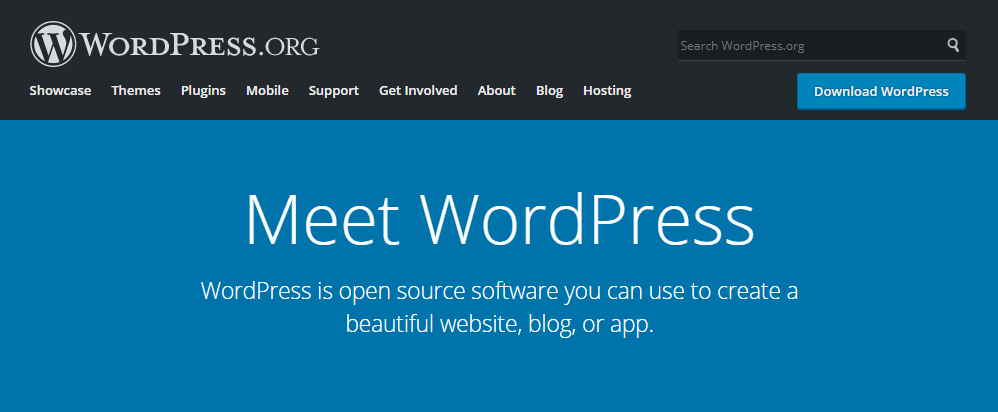
The self-hosted WordPress.org homepage
We’ve covered the difference between WordPress.org and WordPress.com in a lot more detail, but here’s the short version:
WordPress.org, often called self-hosted WordPress, is the free, open-source WordPress software that you can install on your own web host to create a website that’s 100% your own.
WordPress.com is a for-profit, paid service that is powered by the WordPress.org software. It’s simple to use, but you lose much of the flexibility of the self-hosted WordPress.
Most of the time, when people say “WordPress”, they mean the self-hosted WordPress available at WordPress.org. If you want to truly own your website, self-hosted WordPress.org is almost always the best option.
All you need to do to get started with self-hosted WordPress is purchase web hosting and a domain name.
Who Made WordPress And How Long Has It Been Around?
WordPress was created as a standalone project all the way back in 2003, originating as an offshoot of a previous project called b2/cafelog.
WordPress is open-source software, so nowadays it’s made by a huge community of contributors. But if we were to trace WordPress’ origins back to its roots, its original creation was a collaboration between Matt Mullenweg and Mike Little.
Since then, Matt Mullenweg has largely become the face of WordPress. And he’s also the founder of Automattic, which is the company behind the for-profit WordPress.com service.
The history of WordPress between its founding as a blog platform back in 2003 and today is a long one...
But suffice it to say, WordPress has pushed forward and, thanks to its contributors and huge community, developed into the most popular solution to create any type of website.
Who Uses WordPress?
WordPress is used by individuals, big businesses, and everyone in between! On an immediate note, we use WordPress! So the very site that you’re looking at right now is powered by WordPress. Lots of other well-known entities use WordPress as well. Here are some of our favorite examples:
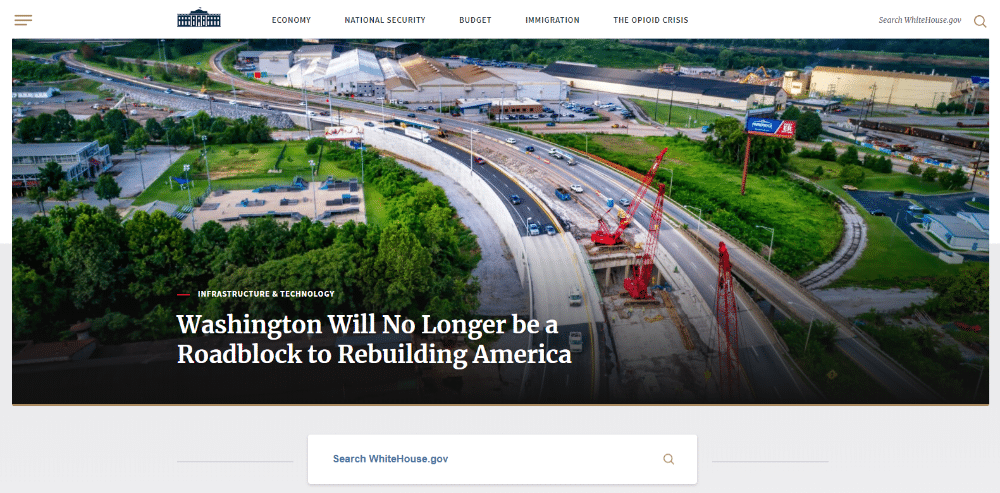
Whitehouse.gov
The official Whitehouse.gov website is powered by WordPress:
Whitehouse.gov is powered by WordPress
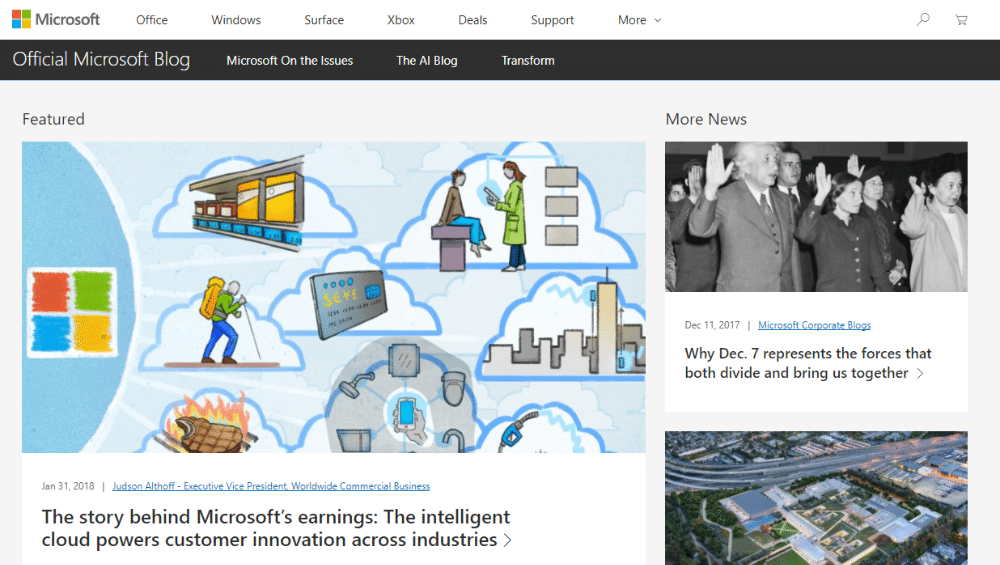
Microsoft
Microsoft uses WordPress to power its official blog. It also uses WordPress to power blogs for specific products like Windows and Skype:
The Rolling Stones
Even famous bands love WordPress! The Rolling Stones’ website is powered entirely by WordPress:
The Rolling Stones band website uses WordPress
Why Should You Use WordPress?
Ok, so over 37.6% of all the websites on the Internet are using WordPress, including well-known entities like the White House and Microsoft.
But what about you? Why should you use WordPress?
Well, no matter what type of website you want to create, there are plenty of reasons to use WordPress. Here are some of the biggest:
WordPress Is Free And Open Source
One of the biggest benefits of WordPress is that it’s free, open-source software. While you will need to pay a little bit for hosting, you will never have to pay just to use the WordPress software, which isn’t the case with alternatives like Squarespace.
Beyond that, you can also find lots of open-source plugins and themes to change how your website looks and functions. Speaking of….
WordPress Is Extensible
Even if you aren’t a developer, you can easily modify your website thanks to WordPress’ huge ecosystem of themes and plugins:
Themes – these primarily change how your website looks.
Plugins – these primarily change how your website functions. Plugins can be something small, like a contact form, or huge, like creating an eCommerce store.
Currently, there are over 50,000 free WordPress plugins and 5,000 free WordPress themes, as well as tons of premium options. That to say – you have plenty of choices! Here is a hand-picked list of the best WordPress plugins.
WordPress Is Easy To Install
Think you need to be a tech genius to create your own website? Think again! If you can click a few buttons, you can install WordPress on your site.
Nowadays, most web hosts either:
Offer to preinstall WordPress for you so that your site is ready to go right away.
Give you dedicated tools that make the install process very beginner-friendly.
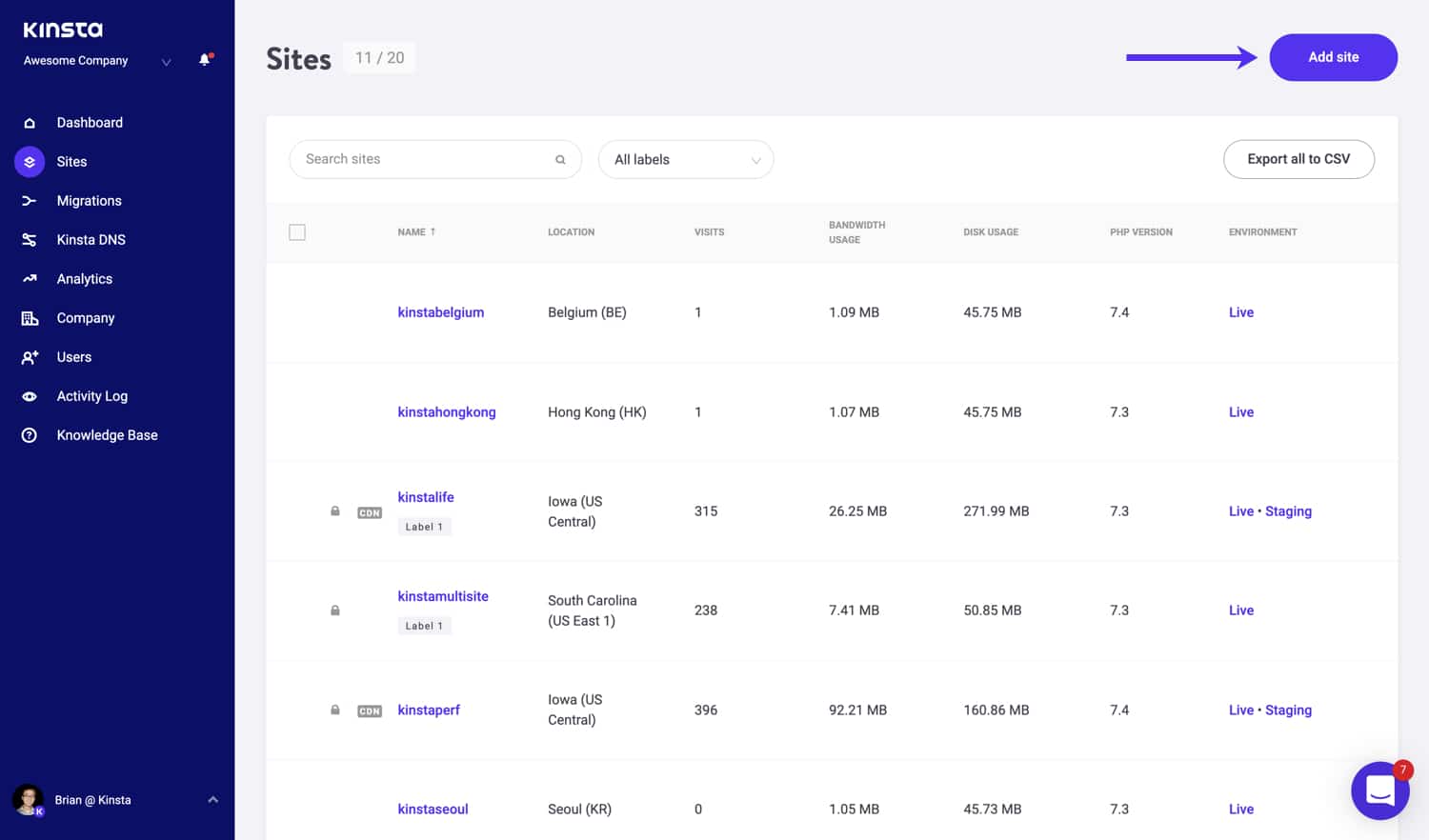
Create a new WordPress site
WordPress Is Flexible
We’ve touched on this already, but WordPress is great because it lets you create pretty much any type of website. Better yet, your website can also evolve with you.
Want to add a forum to your existing WordPress site? No problem – just install the bbPress plugin! Want to add a social network? No worries! Just use the BuddyPress plugin.
You’re never locked into a specific set of functions – you can always adapt and evolve.
We’ve taken our knowledge of effective website management at scale, and turned it into an ebook and video course. Click here to download the The 2020 Guide to Managing 40+ WordPress Sites!
It’s Easy To Find WordPress Help
Because WordPress is so popular, it’s easy to find help if you ever run into any issues. There are heaps of…
Blogs
Tutorials
Forums
Facebook Groups
Developers
…that you can turn to for free and paid help if needed.
Need More Convincing?
Still not convinced that WordPress is the best way to build a website?
So What Is WordPress? It’s The Best Way To Build A Website
WordPress is the most popular way to build a website for a reason. If you want to build any type of website, from a blog to an eCommerce store, WordPress is a great option.
Just remember that self-hosted WordPress.org and WordPress.com are not the same thing. And, in most situations, self-hosted WordPress.org is what you want to build a website. Self-hosted WordPress.org gives you more ownership as well as access to all the perks and benefits of the WordPress community.
So how will you use WordPress? We can’t wait to find out!
If you enjoyed this tutorial, then you’ll love our support. All Kinsta’s hosting plans include 24/7 support from our veteran WordPress developers and engineers. Chat with the same team that backs our Fortune 500 clients.
There are many ways to monetize your website traffic, and most of them are related to advertising third-party products or services to your website visitors. There are many advertising programs that can help you earn money nowadays, but the most popular is Google AdSense.
This advertising program was launched in mid2003 by Google and is currently the most popular advertising program on the Internet. It provides a good opportunity for webmasters and site owners to monetize their traffic - every year, Google pays over $10 billion to its publishers. If you’ve asked yourself, ‘What is AdSense, and how do I make money with AdSense?’ the following article will give you some hints.
High level of security, safety and transparency for both advertisers and publishers. This is another good feature of AdSense. Google acts as an intermediary between the two sides and is mindful of the whole process being transparent and clear for everyone. All the necessary metrics can be tracked within your Google Analytics account.
Variety of ad formats. In AdSense, advertisers can run text, images, HTML ads, video ads and much more, and in many different sizes. As a publisher, you can experiment with different ad types and figure out which ones drive the most revenue.
Tip: check which sizes are the most used by other publishers and learn from them. For example, in our own study, based on the analysis of over 63,000 advertisers and publishers, we found out that the most popular ad sizes are 728x90 and 300x250:
How Does AdSense Work?
The whole process is quite simple. You create an AdSense account, insert a small amount of code into your website pages – and that’s all you need to start. Google will display targeted ads on your page that are either relevant to the content of your website or to users’ previous searches, based on its proprietary algorithms.
Your website visitors will start clicking those ads and - the best part - you will be paid for it. Google AdSense works on a cost-per-click and revenue-sharing basis. This means that your main task will be to provide as many clicks to those ads as possible.
Tip: do not try to cheat Google and artificially increase the number of clicks. Do not encourage your website visitors to click ads and - of course - do not click your own ads under any circumstances! Google has a very accurate and complicated system for preventing click fraud. Once it notices some suspicious activity on your website or has any doubts about the quality of your traffic and clicks, it may suspend your account.
How Much Can You Earn With AdSense?
Google charges advertisers per ad click. Publishers get 68% of the click amount (or 51% when it comes to AdSense for search).
The commission you get depends heavily on the competition and CPC in the niche. In practice, the commission per click can range from $0.20 to $15. The majority of niches bring less than $3 per click to publishers. However, there are some niches that can be extremely profitable.
There are two ways to discover the most profitable topics:
1. Estimate an average cost per click in the niche with the CPC Map tool:
You can see that the three most expensive niches in the US are Insurance, Online Education and Marketing & Advertising. If you are just about to start a blog and choosing the topics to cover, these numbers will be extremely useful for you.
This tool is powered by the biggest keyword database in the world (over 14.6 billion keywords as of August 2019). You can just enter a seed keyword (“adsense”, for example) and it will give you tons of related search terms with CPC, search volume and competition level for each of these terms.
Tip: the amount you earn doesn’t solely depend on the cost per click value in your niche. It also depends on how ads match your audience interests, where the ads are located on the page, etc. So pay attention to the content of your website, its look and feel, and test different placements within a page to find the most efficient option.
Traffic Is The King
Finally, and most importantly, your earnings also depend on the amount of targeted traffic to your website. You can choose the most expensive niche and pick the best placements for your ads, but it doesn’t make sense if nobody comes to your website or blog. Keep in mind that only a very small number of your visitors will click the ads (there are no official statistics from Google, but usually webmasters report that 1% to 2% is quite a good CTR). Most probably, the clicks will bring you less than $1 per click. Now you can calculate yourself how much traffic you need to earn the amount you want. Therefore, if you want to make money with AdSense you should have large volumes of traffic. This will require a lot of work and a lot of unique and quality content.
This means that it is always reasonable to create a website on a topic you know a great deal about. It will be much easier for you to generate a lot of quality content and this work will be pleasurable. Do not expect to make $1,000 per month with a 10-page website. It is recommended to create at least 20-30 pages of content before you start working with AdSense.
Summary
Briefly summarizing, you can make pretty good money with Google AdSense, but it is not a program where you can get rich quickly. There are some common sense rules to follow that will help you lay the groundwork for high and stable earnings:
Love the topic you are writing about and know a lot about it.
As well as producing unique and relevant content, do it on a regular basis to make Google aware that your website is being updated constantly with fresh information.
Do not try to cheat Google with any kind of “artificial” clicks.
Do some research to find the most profitable niches in terms of CPC and search demand. Build your content plan according to these insights.
This will help you to get a lot of traffic and monetize it with AdSense.




' x='0' y='0' height='100%25' width='100%25' xlink%3Ahref='data%3Aimage/png;base64,iVBORw0KGgoAAAANSUhEUgAAAAoAAAAFCAIAAADzBuo/AAAAo0lEQVQImWMQWjVbdt1MxmXzOJbPFlo1DciAIO3FU3kWzWBgXjyHd+405oUzuOdNk1w8X2rxfItFi9UWTZtc2qgzdTKD5PxpLQvbDef05y6enDytJmdK4eL2mLgpFTeb/GxntzPIrZiwakek1eqW3q2pSRvK0jeWNG3J9lhbv2BHgtbKLgbGpXMZl85jAJMcKxZwr1zItWIh76pF4muXca5YAADLq0XQ4iANdQAAAABJRU5ErkJggg=='%3E%3C/image%3E%3C/svg%3E)

' x='0' y='0' height='100%25' width='100%25' xlink%3Ahref='data%3Aimage/png;base64,iVBORw0KGgoAAAANSUhEUgAAAAkAAAAGCAIAAACepSOSAAAArUlEQVQI1wXBMQ/BQBQA4Lv3zvV6TyiqFkPZrBKj1dw/x2o2WERiMbI1hJAgHcRMCOGuSPg+PhkOBEmSMoucoSg2WhUEkBnGQdjZWDfbfr2WdZ3UmOsmHsXb5W5PjPHVfOrmy5oIARHB3m/J4fhgX3O5idUr8D+29LRKKURkDAtBkFN5XTU8DENrrXJU+k6JKEmSfrfXiaLz6SSICDhIR2rSAOB5Hv/9tot1LsP/9Yo4iyTvyIwAAAAASUVORK5CYII='%3E%3C/image%3E%3C/svg%3E)

' x='0' y='0' height='100%25' width='100%25' xlink%3Ahref='data%3Aimage/png;base64,iVBORw0KGgoAAAANSUhEUgAAAAcAAAAHCAIAAABLMMCEAAAAc0lEQVQImU2M2wrCQAxE8//f54PghQqtNGtbIk13TbpNjGjB8zCQmXDg0qbbHRETZTXzL/CYRerWTvlzLYv3fSRMrPGRnnvbdc4MxGUzw3RVOjqfagxhyFJDdx5ec1HfgYFFqx1QmrEUWX8t5TW8SNn/eANc0Y2gNrkDgQAAAABJRU5ErkJggg=='%3E%3C/image%3E%3C/svg%3E)

' x='0' y='0' height='100%25' width='100%25' xlink%3Ahref='data%3Aimage/png;base64,iVBORw0KGgoAAAANSUhEUgAAAAsAAAAFCAIAAAAcxIEBAAAAeUlEQVQI1yXKOxKCQBRE0dvzEYsxdCHuP3MjroCIQgqGmtcGnvhoWRZJrbXYtslOzyfrOnrvNY+5JlTqfR7hc/D+HK3yun3TtnMcoz2kCui4RpgpA+xnL6UW2XbOGbisZOjDYSRhbIcdEQBgOwkkkgBSkiRspP+Q9AM0Uj+l6orXggAAAABJRU5ErkJggg=='%3E%3C/image%3E%3C/svg%3E)


